Cyprus appeals to Americans looking for more than a change of address: over 300 days of sunshine, widespread English, accessible healthcare, and a bilateral US–Cyprus income-tax treaty.
There are more than 10 ways to obtain Cyprus residency, including by investing €300,000, or $348,000.
This guide explains what you need to know about moving to Cyprus from the US, including residence, taxes, living costs, healthcare, property, and daily life.




For Americans weighing a move to Europe, Cyprus stands out for a rare mix of practicality and lifestyle: an EU base, Mediterranean weather, English-friendly daily life, and a notably lower-crime setting. EU membership brings access to the single market[1], while the island’s sub-million population keeps daily life far removed from the scale and intensity of major US cities.
For Americans, Cyprus offers access to a permanent residence route. Entry starts at €300,000, or around $348,000, investment in property, a Cyprus company, or eligible funds.
The status has unlimited validity and leaves freedom around where and how you live: to maintain the permit, holders need to visit Cyprus only once every 2 years. The American family can spend most of the year elsewhere, keep Cyprus as a Mediterranean base, and still enjoy easy access to the coast, international schools, and affordable private healthcare.
Cyprus gives US-sourced income noticeably more reach: overall living costs are estimated at around 20% below US levels, while housing is roughly 30—40% cheaper. Against expensive US cities, the gap widens further — Nicosia is currently estimated to cost around 60% less than New York City[2].
The advantage is strongest for remote workers, business owners, retirees, and investors who keep income tied to the US rather than local salaries. Average gross monthly earnings in the US were about $5,600 in 2025[3], versus €2,932 in Cyprus, which equals $3,400[4].
The US–Cyprus income-tax treaty is a key advantage for Americans, helping coordinate tax obligations between the two countries and reduce the risk of double taxation.
Cyprus then adds its own favorable treatment: non-domiciled residents are exempt from Special Defence Contribution on dividends and interest[5], while foreign pensions can be taxed at 5% on income above €5,000 per year[6].
Foreign citizens in Cyprus make up about 25% of Cyprus’s population — roughly 1 in 4 residents[7]. Major expatriate communities include British residents and nationals from across Asia[8].
The international mix makes English a natural part of everyday life in Cyprus: around 75% of the local population can communicate fluently in English, and the language is widely used in business, public services, tourism, healthcare, and higher education[9].
Cyprus gives American founders a lower-tax base inside the EU: corporate income tax is 15%[10], compared with 21% at the US federal level, before state corporate taxes.
The setup supports international companies. Businesses registered as Companies of Foreign Interest can use a simplified route to recruit skilled non-EU employees. At the same time, the government’s Business Facilitation Unit helps with company registration, tax registration, licensing, and coordination with public authorities[11].
Certain business models also benefit: qualifying intellectual-property income can receive an 80% exemption on net profits under Cyprus’s IP regime[12], and entrepreneurs building high-growth innovative companies can apply through the Cyprus Startup Visa[13].
Living in Cyprus puts much of Europe and the Middle East within easy weekend reach, which makes short breaks, business trips, and visiting friends far more practical.
Routes to popular European cities from Larnaca and Paphos take 1.5 to 5 hours, depending on the destination. Short-haul return fares can start at €50—100, while flights to London and other major Western European cities often fall in the €100—200 range, depending on season and booking time.
Cyprus makes it possible to live close to the Mediterranean without feeling permanently surrounded by holiday crowds. Outside the main resort zones, coastal cities and residential areas keep a local, year-round rhythm.
The island supports an outdoor lifestyle across all seasons, with dry summers, mild winters, and around 6 hours of daily sunshine even in December and January. Temperatures range between +61…66°F in winter and +86…91°F in summer, with blossoming springs, warm golden autumns, and plenty of opportunities for swimming, sailing, hiking, and cycling.

Cyprus gives Americans time to test the move before committing: up to 90 days visa-free for tourism or business, enough to explore neighborhoods, view property, and get a feel for everyday life.
Staying longer means choosing a residence route that fits the way income, work, and family life are structured — from remote work and foreign income to employment, study, startups, and investment.
Who it’s for. This route is for Americans and other third-country nationals who want a permanent base in Cyprus without tying their status to a local job. It works especially well for families, internationally mobile investors, and founders who want Cyprus as part of a broader business or lifestyle setup.
Requirements. The investment must be at least €300,000, or about $348,000, and can take one of four forms:
On top of the investment, the main applicant must show a secure annual income of €50,000 from abroad, plus €15,000 for a spouse and €10,000 for each dependent minor child. In US dollars, this is about $58,100, $17,400, and $11,600, respectively.
Applicants also need to have a clean criminal record and private health insurance.
Validity. The permit gives permanent residence in Cyprus from the outset. To maintain the status, investors and their families must visit Cyprus at least once every 2 years.
Family eligibility. A spouse and children under 25 can be included in the application. Children over 18 must be students of a tertiary education institution, unmarried, and financially dependent on the investor.
Who it’s for. The Digital Nomad Visa suits Americans employed by a foreign company or working remotely with overseas clients. Employment or paid work for Cyprus-based businesses is not permitted[14].
Requirements. Applicants need to prove a net monthly income of at least €3,500, or about $4,070, with salary evidence and bank statements for the previous 6 months. The threshold rises by 20% for a spouse or partner and 15% for each child.
Validity and family eligibility. The permit is valid for 1 year and may be renewed for up to 2 further years. A spouse or partner and dependent children may reside in Cyprus for the same period, but they cannot work.
Who it’s for. The Pink Slip suits Americans who want to live in Cyprus without working or doing business locally[15]. It is typically used by people supported by passive or foreign-sourced income, such as pensions, dividends, interest, rental income, or savings. Local employment, self-employment, and other economic activity are not allowed.
Requirements. Applicants must show sufficient funds or income from abroad, private health insurance, and a rented or owned home in Cyprus.
Validity and family eligibility. The first permit is valid for 1 year and can be renewed annually while the conditions continue to be met. A spouse and minor children can receive dependent visitor permits linked to the main applicant.
Who it’s for. Category F is intended for Americans with a secure income from abroad who wish to settle in Cyprus without taking up local employment. Eligible sources include pensions, dividends, interest, and rental income[16].
Requirements. Applicants must show a minimum secured annual income of €9,568, plus €4,613 for each dependant, or about $11,100 and $5,360, respectively. These funds must be freely available from abroad and sufficient to support a decent standard of living in Cyprus.
Validity and family eligibility. Unlike the Pink Slip, Category F grants permanent residence with rights of unlimited validity, rather than temporary status renewed year by year. A spouse and children under 18 can also be included[17].
Who it’s for. The Cyprus Startup Visa is designed for Americans building or relocating an innovative, high-growth startup, rather than opening a conventional small business[18].
Requirements. At least 25% of the company’s shares must be owned by one or more applicants under the route.
Beyond this ownership requirement, the innovation criteria depend on the company’s stage:
The startup can employ third-country nationals for up to 50% of its workforce. Additional foreign hiring is possible where investment in Cyprus reaches at least €150,000.
Validity and family eligibility. Residence can be granted for up to 3 years, with a possible 2-year renewal if the startup continues to meet the program criteria. Founders and senior executives may bring family members, while spouses can access the labour market under family-reunification rules.
Requirements. Employment with an international company registered in Cyprus is one of the most practical routes for Americans[19]. For highly paid roles, the employee must earn at least €2,500 gross per month and hold relevant academic qualifications or at least 2 years of professional experience.
Validity. The residence and employment permit can be issued for up to 3 years at a time and renewed. Highly paid employees are not subject to a maximum total stay as long as they continue to meet the conditions.
The employment contract itself must run for at least 2 years. Companies can hire highly paid third-country nationals without a labour-market test or numerical cap, while the permit remains linked to the Cyprus employer.
Family eligibility. A spouse and minor children can join through family reunification. Spouses of eligible employees at foreign-interest companies may also take up paid employment in Cyprus without the usual labour-market approval.
Who it’s for. The EU Blue Card is a route for highly qualified Americans taking eligible professional roles in Cyprus. In 2026, it is limited to ICT, pharmaceutical research and maritime professions, excluding captains and ship crews[20].
Requirements. Applicants need a gross annual salary of at least €43,632 and a relevant higher-education qualification of at least 3 years. For ICT managers and professionals, a degree can instead be replaced by at least 3 years of relevant experience gained within the previous 7 years.
Validity. In Cyprus, an EU Blue Card is valid for 2 to 3 years, depending on the employment contract. This type of permit allows short professional stays in other participating EU countries for up to 90 days in any 180-day period and, after 12 months of legal residence, a move to a second member state for highly qualified employment under the Blue Card mobility rules.
Family eligibility. Family reunification covers a spouse and unmarried children under 18. Family members receive free access to employment and self-employment in Cyprus.
Who it’s for. Americans taking salaried roles outside the EU Blue Card or foreign-interest-company routes may use the standard temporary residence and employment permit[21].
Requirements. Eligibility depends on the occupation, employer, and labour-market rules, with no single salary threshold. The employer must secure the required entry permission before the employee arrives, and the permit remains tied to the approved job.
Validity and family eligibility. Permits can be issued for up to 3 years and renewed, although the total stay is capped at 4 years for most categories. Family reunification may become available once the sponsor meets the applicable residence requirements.
Requirements. Americans accepted by a Cyprus university or higher-education institution can obtain temporary residence for studies lasting more than 90 days. Applicants need proof of admission, sufficient funds, and accommodation[22].
Validity. A Cyprus student residence permit is issued for up to 1 year and can be renewed annually until the program is completed, provided the student remains enrolled and keeps up with the curriculum.
Rights. International students may work in approved occupations for up to 20 hours per week during term and 38 hours during official study breaks.
Graduates who complete a master’s degree or higher may remain in Cyprus for up to 12 months to look for suitable employment or establish a business.
Sponsor requirements. Americans may qualify for residence through family reunification when a spouse or parent already holds an eligible Cyprus residence status[23].
Under the route, the sponsor must:
More favorable rules apply to some groups, including researchers, intra-corporate transferees, and certain employees of foreign-interest companies. These categories may benefit from faster family reunification and avoid the standard 2-year waiting period.
Eligible family members. A spouse must be at least 21, with the marriage in place for at least 1 year before the application. Eligible children are unmarried minors.
Spouses gain access to employment under the conditions linked to the sponsor’s residence category.
Validity. The first family residence permit is issued for 1 year and can be renewed, but not beyond the validity of the sponsor’s own permit.
| Route | Who it suits | Validity | Local work rights | Path to permanent residence |
| Investment | Investors, families, founders | Permanent | May hold shares and act as an unpaid director | Immediate permanent residence |
| Digital Nomad Visa | Remote workers for foreign employers or clients | 1 year + up to 2-year renewal | None | None |
| Pink Slip | Financially independent residents living on foreign income or savings | 1 year, renewable | None | None |
| Category F | Retirees and financially independent income holders | Permanent | None | Immediate permanent residence |
| Foreign-interest company employment | Skilled employees hired by international companies in Cyprus | Up to 3 years, renewable | For the sponsoring employer | After 5 years |
| EU Blue Card | Highly qualified professionals in eligible sectors | 2—3 years, renewable | In qualifying highly skilled employment | After 5 years |
| General employment permit | Employees hired for other eligible Cyprus-based jobs | 1—3 years, renewable | For the approved job | After 5 years |
| Startup Visa | Founders of innovative, high-growth startups | Up to 3 years + possible 2-year renewal | Within own startup | After 5 years |
| Student residence | Students at Cyprus higher-education institutions | Up to 1 year, renewable during studies | Up to 20 hours a week | None |
| Family reunification | Spouses and minor children of eligible Cyprus residents | 1 year, renewable | Depends on sponsor’s status | After 5 years |
A move to Cyprus works best when residence planning and the practical relocation run in parallel. Around 6 months before departure is a sensible point to begin gathering US documents and apostilles, researching neighborhoods and schools, and preparing the financial side of the move.
The timeline below uses permanent residence by investment as the example. Based on Immigrant Invest’s experience, obtaining Cyprus PR through investment takes at least 9 months. Most of the process can be handled from the US: our lawyers prepare the file, coordinate the investment, and submit the application in Cyprus, with a personal visit required later for biometrics and final formalities.
Immigrant Invest begins with a confidential background review. Our certified Anti-Money Laundering Officer checks the applicant’s personal and financial profile against international databases and flags issues that could affect the application.
If anything needs clarification, our lawyers decide how best to address it before the investor commits to the property or other asset.
The lawyers complete the application form and build the supporting file for the investor and accompanying family members. The standard package includes:
US documents in English usually do not need Greek translation, but they must still be properly certified.
This is also a good stage to shortlist neighborhoods and schools, compare long-term housing options, and decide whether the property will become a family home. Starting early is especially useful when several US civil documents need to be ordered and apostilled.
The investor chooses one of 4 options. Our team can shortlist suitable properties or help structure another eligible investment, while our lawyers check the transaction and prepare the legal documents.
For a property purchase, we coordinate the acquisition in Cyprus and handle the required filings. Where the property will become the family home, this stage can settle both the investment requirement and one of the main relocation decisions.
Investors choosing commercial property, company shares, or fund units will still need separate residential accommodation in Cyprus.
Once the investment and documentation are complete, our representative files the permanent residence application with the Cyprus Migration Department and manages communication with the authorities while the case is reviewed. Applicants can remain in the US during this stage.
While the application is progressing, the family can finalize accommodation, school places and private health insurance, book flights and organize household shipping. It is also worth preparing bank statements, tax returns, and source-of-funds records in advance, as Cyprus banks may request them when opening an account or receiving larger transfers.
After approval, the investor and family members included in the application travel to Cyprus for biometrics. Our lawyers arrange the appointment in advance and guide the family through the remaining residence formalities.
For US passport holders, a separate short-stay visa is not required for visits of up to 90 days, making the biometric trip relatively straightforward.
Residence cards are issued after biometrics and must be collected in person from the Migration Department. Our working timeline allows up to around 1.5 months for this final stage.
Permanent residence itself is granted indefinitely, while the residence card is renewed every 10 years. To keep the status, the family must continue meeting the program conditions and visit Cyprus at least once every 2 years.
During the first month, the practical priorities usually include:
Our support does not end when the residence cards are issued. The Immigrant Invest team can assist with Cyprus bank-account documentation, additional apostilles and certified documents, property matters, and later residence-card formalities.
Cyprus makes it easy to bring the essentials of home: furniture and personal belongings can often arrive with duty and VAT relief, pets can travel with the right paperwork, and even a private car may qualify. The car is the one item worth checking carefully before shipping, as registration rules can be more restrictive.
If you are relocating your normal residence from the US to Cyprus, your personal belongings may qualify for relief from Cyprus import duty and VAT under the transfer-of-normal-residence regime[24].
To qualify for the regime, the following requirements apply:
Goods should normally be imported within 12 months of establishing normal residence in Cyprus. They may arrive up to 6 months earlier, subject to the relevant undertaking and any security required by Customs. Goods admitted under the relief cannot be sold, lent, hired out, or otherwise transferred for 12 months without notifying Customs.
To claim the relief, submit Form Ap.2 to Cyprus Customs together with evidence of your previous residence, your move to Cyprus, and ownership and use of the goods. The application must be signed in the presence of a Customs officer.
Dogs, cats, and ferrets arriving from the US must meet Cyprus and EU animal-health requirements. The main requirements are:
For a non-commercial move, normally no more than 5 pets may travel, and they must accompany the owner or an authorized person within the permitted 5-day window. Cyprus Veterinary Services must be notified of the arrival time and flight or vessel details at least 48 hours in advance. Pets must enter through an authorized point of entry and are checked on arrival[26].
An EU pet passport is not issued in the US, so the endorsed EU animal health certificate is used instead.
A private vehicle may also qualify for relief from import duty and VAT under the transfer-of-normal-residence regime. Relief is available for one private-use vehicle per person who holds a valid driving license[27].
The main conditions are that:
Customs clearance and vehicle registration are separate processes. To claim the relief, the owner submits Form Ap.2 and supporting evidence, which may include:
Once Customs clears the vehicle, it issues Form C72A, which is then presented to the Department of Road Transport for inspection and registration.
US vehicles may be subject to additional registration and technical requirements, including Single Vehicle Approval or other type-approval procedures[28]. Because vehicles imported from outside the EU can be subject to registration restrictions, it is advisable to confirm that a particular vehicle can be registered in Cyprus before arranging shipment.
With shipping and registration costs, importing is usually worthwhile only for valuable, rare, or personally significant vehicles.

A move to Cyprus has two budgets: the cost of getting there and the cost of living once the boxes are unpacked. Flights, deposits, shipping, and setup shape the first few months. After that, spending comes down to the home, city, schools, transport, and the kind of lifestyle the family wants to maintain.
Compared with the US, both the move and everyday life can be relatively manageable, especially outside the most expensive parts of Limassol.
The move itself is less about one large bill than a series of upfront costs: flights, a home deposit, shipping, school fees, utilities, and the small purchases that turn an address into a functioning household.
Typical one-off expenses include:
For a family, a comfortable reserve for the first 3 months starts at around $9,000 if there is little to ship and no need to budget for a car or private school. With relocation costs, a vehicle, and school fees included, the total can rise to $23,000.
For day-to-day life in Cyprus, a single person can budget around $1,600—2,800 a month, including rent, while a family of four may spend roughly $4,000—7,000, depending on the city, home, and schooling. Limassol sits at the premium end, followed by Paphos, while Nicosia and Larnaca tend to stretch the budget further.
Utilities are fairly restrained for much of the year, although summer air conditioning can quickly push electricity bills up. Water, broadband, and mobile costs are more predictable. The table below shows how a typical monthly budget can break down for different household sizes.
| Budget line | Single | Couple | Comfortable living for a couple | Family of 4 |
| Rent | $800 | $1,160 | $1,510 | $1,510 |
| Utilities | $100 | $190 | $210 | $370 |
| Groceries | $280 | $530 | $640 | $1,160 |
| Fuel | $160 | $160 | $210 | $230 |
| Schooling | — | — | — | $1,510 |
| Health insurance | $50 | $100 | $100 | $180 |
| Dining out | $230 | $460 | $690 | $930 |
| Leisure | $180 | $290 | $460 | $695 |
| Total | $1,800+ | $2,890+ | $3,820+ | $6,590+ |
For newcomers, renting first offers time to learn Cyprus before committing to a purchase. A year is usually enough to compare cities, neighborhoods, commutes, and coastal access. Buying makes more sense once those preferences are clear, especially for families settling long-term or investors linking property to residence.
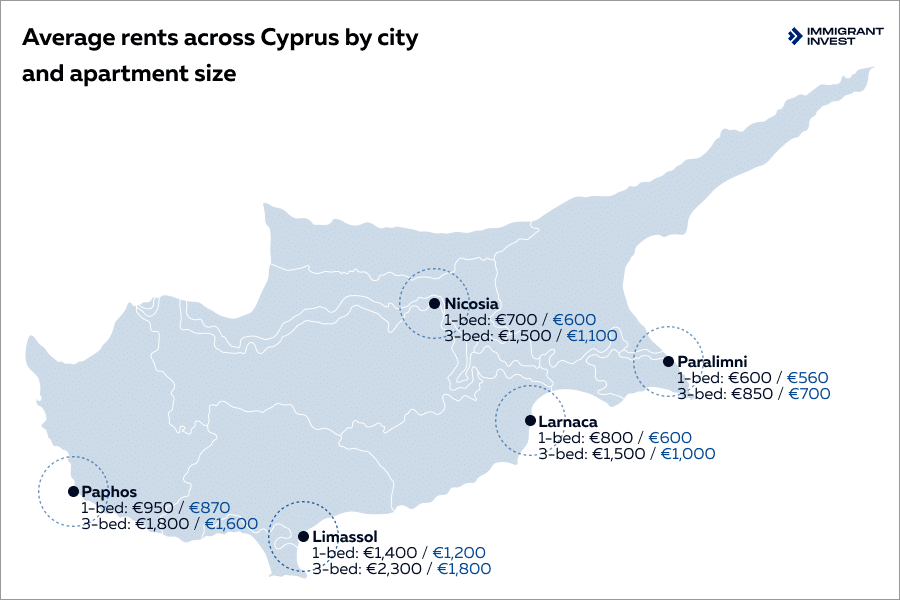
Limassol sits at the top of the market, with a 1-bedroom apartment outside the centre at about $1,400 a month, while Paralimni can be closer to $580—700[29]. Nicosia, Larnaca, and Paphos fall somewhere in between.
Tenants commonly put down a deposit equal to 2 months’ rent, and an estate agent may charge around 1 month’s rent plus 19% VAT. Furnished homes carry a 15—25% premium, while communal fees in apartment buildings can add about $35—175 a month.
1-year leases are the norm. Shorter stays are possible, but they usually cost more — another reason many new arrivals rent for a year, learn the area, and only then decide whether they want to buy.
Prices per m² in Cyprus change sharply between central districts and the suburbs:
Purchase costs depend on whether the home is new or resale. New property is subject to 19% VAT, with a reduced 5% rate available for qualifying primary residences[30]. Resale homes instead attract Land Registry transfer fees of 3—8%, currently reduced by 50%. Where VAT applies, no transfer fee is charged[31].
For American buyers, the paperwork is hefty. A lawyer should check the title deed, mortgages and other encumbrances, the developer’s track record, and any expected delay in issuing an individual title deed. A new-property purchase of at least €300,000, or around $348,000, can also form the basis of a Cyprus permanent residence application.



Americans can choose between public and private healthcare, find established international schools, and manage day-to-day finances without much friction once the initial paperwork is in place. Most of it can be handled in English.
Healthcare is one of Cyprus's strongest expat-rated areas, ranking 4th in the 2025 Expat Insider survey. This indicates high expat satisfaction with the affordability, availability, and quality of medical care[32].
Public healthcare. For Americans used to monthly premiums, deductibles, and large out-of-pocket bills, Cyprus healthcare can feel much lighter on the household budget. Costs are kept predictable through low or no co-payments for many services:
For comparison, US employer-sponsored health plans averaged $9,300 a year for single coverage and $27,000 for a family, before considering deductibles and other cost sharing.
Private healthcare. Many newcomers still keep private cover for greater choice and quicker access to specialists. Policies can start at roughly $460—1,400 a year, while broader international-style cover may reach around $3,500.
English is widely used in private clinics and hospitals, making appointments and ongoing family care relatively easy to manage after the move.
Public education in Cyprus is free, but teaching is mainly in Greek, so many American families look to private and international schools for English curriculum.
Some of the better-known options include:
Tuition rises as children move through the year groups, although fees vary considerably between institutions[33]. Families can expect annual tuition of around $6,700—11,600 in primary school and $9,300—11,600+ per child in secondary school.
It is worth securing a school place before committing to a long lease, especially where the daily school run will influence the neighborhood choice. Admissions can involve school reports, ID documents, and placement tests.
Getting set up. A Cyprus account quickly becomes useful for rent, utilities, local cards, and everyday payments. Banks usually ask for:
The US bank compliance FATCA law adds an extra layer of paperwork, so US citizens may also need to provide a Tax Identification Number and tax self-certification. For property purchases or larger transfers, having bank statements and tax records ready can make the process smoother.
Banks. The main banks in Cyprus include Bank of Cyprus, Hellenic Bank, Eurobank Cyprus, Alpha Bank Cyprus, AstroBank, Ancoria Bank, and the National Bank of Greece.
Everyday banking. English-language online banking and support are widely available, but fully remote account opening from the US should not be assumed. An in-person visit is still needed.
A car changes the scale of life in Cyprus. Beaches, villages, and weekend hiking routes become much easier to reach, and outside central Nicosia or Limassol it can be far more practical than relying on public transport.
A valid US driving license can be used in Cyprus for up to 6 months. US licenses are recognized for conversion to a Cyprus license without a new driving test once the holder has established normal residence in Cyprus — in this context, at least 185 days of residence[34].
The application is made in person using Form TOM 7D. An American resident should bring:
Because US licenses are in English, no certified translation is needed. The original foreign license is submitted as part of the conversion process.

Cyprus is small enough to cross in a morning, yet its cities offer very different versions of island life — from boardrooms by the marina to quiet coastal towns where the sea sets the pace.
Limassol. Cyprus at its most international and fast-moving: finance, shipping, tech, restaurants, marinas, and a dense expat circle all sit within the same city. It suits founders and executives who want business close at hand and the Mediterranean outside the office door — at the island’s highest price point.
Nicosia. The choice for people who want substance over sea views. Universities, government, law, consulting, galleries, and year-round city life give the capital more depth than resort rhythm.
Larnaca. Perhaps the easiest city to slip into: the airport is minutes away, traffic is lighter, costs stay moderate, and the waterfront is part of the daily routine, not a weekend escape.
Paphos. More space, less rush. Villas, harbour cafés, nearby wineries, Akamas trails, and one of Cyprus’s largest international communities.

Moving to Cyprus from the US changes where you may become a tax resident, but it does not end your US tax obligations. Americans may need to navigate both systems: continued US federal filing, Cyprus tax residency rules, and local regimes such as non-dom status and the 50% employment-income exemption.
There are two ways to become a Cyprus tax resident: through the 183- or 60-day rule[35].
The 183-day rule applies once a person spends more than 183 days in Cyprus during a calendar year.
The 60-day rule offers more flexibility, but several conditions must be met:
The 183-day rule tends to suit people who make Cyprus their main base and spend most of the year there. The 60-day rule is better suited to a more international lifestyle, where Cyprus is home but work, travel, or family commitments mean spending significant time abroad.

For internationally mobile Americans, Cyprus offers two separate tax advantages that can be particularly relevant after relocation.
The non-dom regime is aimed mainly at investment income. A Cyprus tax resident who is not domiciled in Cyprus can receive dividends and interest without Special Defence Contribution for up to 17 years, provided they do not become deemed domiciled through long-term residence[36].
The 50% employment-income exemption is aimed at higher-earning professionals. It applies where annual employment income exceeds €55,000, or around $63,900, and the individual was not a Cyprus tax resident for at least 15 consecutive years before starting employment. The exemption can apply for up to 17 years[37].
Personal income. Cyprus tax residents are taxed on worldwide income, while non-residents are taxed on relevant Cyprus-source income[38].
Personal income tax follows these brackets:
Property and capital gains. Cyprus levies 20% capital gains tax mainly on gains from Cyprus property and shares in companies holding Cyprus real estate[39].
Property purchases. VAT is 19%, with a reduced 5% rate available for qualifying primary residences. Resale property is subject to Land Registry transfer fees of 3—8%, currently reduced by 50%. No transfer fee applies where VAT is charged.
Business taxation. The standard corporate income tax rate is 15%. Qualifying businesses may benefit from exemptions and preferential regimes, including the Cyprus IP framework[40].
Employment contributions. Employees pay 8.8% Social Insurance on insurable earnings and 2.65% GeSY healthcare, subject to applicable limits, in addition to personal income tax.
Inheritance and wealth. Cyprus has no inheritance tax and no general net wealth tax.
Americans living in Cyprus may still owe US tax, but two common reliefs can reduce the amount due on income earned or taxed abroad.
Foreign Tax Credit. Cyprus income tax paid on foreign-source income can offset US federal income tax on that same income. The credit is limited to the lower of the foreign tax paid or the US tax attributable to the foreign income, and unused credits can usually be carried back 1 year and forward 10 years[41].
Foreign Earned Income Exclusion, FEIE. For 2026, up to $132,900 per person of foreign earned income can be excluded from US federal taxable income. You need a foreign tax home and must meet either the bona fide residence test or spend at least 330 full days abroad in a 12-month period[42].
The same income cannot receive both benefits: if income is excluded under the FEIE, the foreign tax attributable to that excluded income cannot also be claimed as a Foreign Tax Credit.
For Americans moving to Cyprus, the US–Cyprus income-tax treaty is an important part of cross-border tax planning. It helps determine which country has primary taxing rights and how double taxation can be relieved, often through foreign tax credits. This is particularly relevant for income such as dividends, interest, pensions, employment income, and other cross-border earnings.
US tax reporting follows Americans abroad. A move to Cyprus does not end federal filing obligations, and foreign bank or investment accounts can trigger additional disclosure even when no extra tax is due[43].
FATCA. The Foreign Account Tax Compliance Act, FATCA, is the US reporting framework for foreign financial assets and accounts held by US taxpayers. Under the Cyprus–US agreement, Cyprus institutions collect US taxpayer details, including TINs, and report relevant account information to the Cyprus Tax Department for exchange with the IRS.
Americans living abroad may also need to file Form 8938 with their US tax return when specified foreign financial assets exceed:
Form 8938 is filed together with the federal income-tax return and follows the same deadline and extensions.
FBAR. In addition to FATCA, Americans may have to report foreign financial accounts through the Foreign Bank and Financial Accounts Report, FBAR, filed as FinCEN Form 114. It covers accounts such as foreign banks, brokerages, and certain other financial accounts held outside the US.
FBAR becomes mandatory when the combined maximum value of all foreign financial accounts exceeds $10,000 at any point during the calendar year. The threshold applies to the total across all accounts, not to each account separately.
FBAR is filed separately from the federal tax return. It is due on April 15th, with an automatic extension to October 15th.
A move to Cyprus can look simple on paper, but the friction often appears in the details: slower administration, intense summer heat, limited public transport, and island logistics.
For families seeking a second home or long-term backup base, Cyprus works best when treated as a genuine relocation requiring ongoing legal, financial, and practical planning.
Cyprus is an EU member but is not yet fully part of the Schengen Area. A Cyprus residence permit does not give US citizens the right to live or work elsewhere in the EU.
Permanent residence is also not citizenship. The standard naturalization route requires 8 years of legal residence, including a final 12-month continuous period, plus B1 Greek, knowledge of Cyprus, good character, sufficient resources, suitable accommodation, and an intention to remain in the country.
Permanent residence by investment is not an unrestricted work permit. In most cases, investors cannot take local employment, although they may hold shares and act as unpaid directors.
Americans who plan to earn a local salary should choose their immigration route around that goal from the outset.
Cyprus is not uniformly inexpensive. Summer air conditioning can push electricity bills up sharply, while housing costs vary significantly by city and neighborhood.
A realistic budget should include seasonal utilities, a car, insurance, imported goods, international travel, and a buffer for relocation-related expenses.
Moving to Cyprus does not end US tax obligations. US citizens continue filing on worldwide income, even where foreign tax credits or other relief reduce double taxation. Foreign accounts can trigger FBAR and Form 8938 reporting, while European investment funds or foreign companies may create additional US reporting, including PFIC rules.
Americans should take cross-border tax advice before restructuring investments or setting up Cyprus entities.
Cyprus has strong European connections but no direct flights to the US, so trips usually require a connection through a major European hub. That matters for families with close US ties or frequent business travel.
Healthcare needs planning. Original Medicare does not cover treatment outside the US, and residence applicants will need to get private or international insurance in Cyprus with coverage of at least €30,000.
A property that works as a home may not qualify for the intended residence route. For expedited permanent residence through residential investment, the property must meet specific value and eligibility rules. Buying or paying a deposit before confirming those requirements can create an expensive mismatch.
Residence planning should therefore come before the purchase contract, with independent legal checks on ownership, encumbrances, planning status, and title deeds. Immigrant Invest provides such services.
Cyprus banks may require extensive evidence before accepting large transfers or opening accounts for new residents. Investor applicants must usually show a clear trail proving that funds came from abroad. Americans should also expect FATCA-related requests for US tax identification and residence details.
Complex wealth structures should be documented in advance with bank statements, tax returns, company records, and evidence supporting major transfers.
Immigrant Invest is a government-licensed investment migration consultancy operating since 2006, specializing in residence and citizenship programs for investors and their families. We have worked with more than 10,000 clients worldwide.
For Americans pursuing Cyprus permanent residence, support can cover the process from initial planning to post-approval compliance:
We do not provide US tax advice, but we can coordinate with the client's tax advisors to help align the residence process with broader cross-border planning.
Yes, Americans can live in Cyprus full time through several residence routes. These include permanent residence by investment, the Digital Nomad Visa for remote workers, permanent residence for financially independent applicants, a temporary residence permit for people living on foreign income, employment-based routes, the Startup Visa, family reunification, and others.
Yes, Cyprus is cheaper than the US. Overall living costs are around 20% lower and housing is roughly 30—40% cheaper, although prices vary by city and Limassol is the most expensive market.
No, Americans cannot work locally under every Cyprus residence route. The Digital Nomad Visa, temporary Pink Slip for foreign-income residents, permanent residence for financially independent persons and permanent residence by investment restrict local employment, while employment-based permits and the Startup Visa allow work under specific conditions.
For Americans, obtaining Cyprus permanent residence by investment can take around 9 months. Much of the process can be completed from the US, with a later visit to Cyprus required for biometrics and final formalities.
No, Americans do not need to speak Greek to manage everyday life in Cyprus. English is widely used in business, public services, healthcare, banking, tourism, and higher education.
No, Cyprus is not part of the Schengen Area. A Cyprus residence permit does not give Americans the right to live or work elsewhere in the EU. Cyprus plans to join the Schengen Area, but the timing is still uncertain.
Yes, Cyprus permanent residence can eventually lead Americans to citizenship if the naturalisation criteria are met. Under the standard route, applicants need 8 years of legal residence, including a final 12-month continuous period, B1-level Greek, knowledge of Cyprus’s political and social life, good character, suitable accommodation, stable income, and an intention to continue living in Cyprus.
Yes, Americans continue US federal tax filing after moving to Cyprus. Foreign Tax Credit and the Foreign Earned Income Exclusion may reduce double taxation, while foreign accounts can also trigger FBAR and FATCA-related reporting.
The minimum investment for Americans seeking Cyprus permanent residence is €300,000. It can be placed in residential or commercial property, shares in a Cyprus company, or units in an eligible Cyprus investment fund.
Yes, Americans can include a spouse and children under 25 in a Cyprus permanent residence application. Children over 18 must be unmarried, financially dependent, and studying at a tertiary education institution.
Renting first is usually the more practical option for Americans moving to Cyprus. A year gives newcomers time to compare cities, neighborhoods, commutes, and coastal access before committing to a property purchase.
Shipping belongings from the US to Cyprus costs $3,000—5,500 for a smaller shared-container move. A full-service 20-foot container costs roughly $5,000—12,000+, depending on volume, departure point, packing, insurance, and delivery.
If required US documents are not apostilled, a Cyprus permanent residence application may be delayed until the file is properly certified. FBI criminal-record checks and state-issued birth or marriage certificates must be authenticated or apostilled by the appropriate US authority where required.