Cyprus issues short-stay and long‑stay visas to non-EU citizens. Short‑stay visas are primarily issued for tourists but can also be obtained for business trips, family visits, or medical treatment.
Long-stay visas often serve as a bridge towards residence permits for work, study, or family reunification. Wealthy foreigners have an alternative path to Cyprus residency: by investment of at least €300,000 in real estate, a local business, or investment fund units.
This article explains the types of visas and residence permits for short and long stays in Cyprus.




Visa requirements for foreigners who plan to travel to Cyprus vary depending on their nationality, purpose, and duration of stay.
EU nationals. Citizens of EU countries, Switzerland, Iceland, Liechtenstein, and Norway do not need a visa to travel to Cyprus. They can enter with a valid passport or a national identity card with a photo.
To stay in the country for more than 90 days, EU citizens and their family members can obtain MEU1 and MEU2 residence permits through a simplified procedure. EU citizens can obtain a registration certificate without an expiration date, while their family members are eligible for a five-year residence card.
Non-EU nationals. Citizens of countries with visa-waiver agreements with Cyprus can visit the country for up to 90 days within a 180-day period. The list includes the United States, the United Kingdom, Canada, Australia, Japan, South Korea, and the UAE.
Nationals of countries without visa-waiver agreements with Cyprus need to obtain a short‑stay Category C visa that will allow them to stay in the country for up to 90 days. However, if they hold a valid Schengen multi‑entry visa, long‑stay visa, or residence permit issued by a Schengen country, they can enter Cyprus for up to 90 days without additional documents.
A long-stay visa, also known as a Category D visa, is required for non-EU nationals who intend to stay in Cyprus for more than 90 days. However, to remain in Cyprus for more than a year, they must obtain a residence permit.
Residence permits are granted for reasons like work, study, doing business, or family reunification. Alternatively, foreigners can invest at least €300,000 to obtain Cyprus permanent residency by investment.
Tourist visa. The most common visa type is issued to individuals visiting Cyprus for leisure, sightseeing, or personal reasons. It does not allow employment or other gainful activities.
Some individuals who can provide proof of frequent visits to Cyprus and other EU countries may be granted a multi-entry visa valid for up to 3 years and, in exceptional cases, for up to 5 years. However, holders of such visas can only stay in Cyprus for up to 90 in any 180 days within the validity period.
Business visa. This document allows individuals to enter Cyprus for professional purposes, such as attending meetings, conferences, or signing contracts. Frequent travellers can obtain a multi-entry visa for 1—5 years, but the total duration of stays cannot exceed 90 days in any 180-day period.
Applicants must provide an invitation letter from a Cypriot company or organisation and explain the purpose of their visit. Employment in Cyprus is not permitted under this visa.
Study visa. This visa is granted to individuals attending courses or educational programs in Cyprus lasting less than 90 days. Examples include language courses or short-term training programs.
To obtain the visa, applicants must provide proof of enrolment in the qualifying program. Longer educational programs require a long-term student visa.
Transit visa. This document allows travellers to pass through Cyprus en route to another destination. A regular transit visa can be issued for no more than 5 days, and its holders are allowed to enter Cyprus territory.
An airport transit visa is typically valid only for under 24 hours and does not allow leaving the international area of the airport. However, this document is only required for citizens of 13 countries, including Afghanistan, Bangladesh, DR Congo, Eritrea, Ethiopia, Ghana, Iran, Iraq, Nigeria, Pakistan, Somalia, Sri Lanka, and Turkey.
Applicants for transit visas must provide a confirmed onward travel ticket and a visa for their final destination if required.

To apply for a short-stay visa to Cyprus, applicants must visit the nearest Cyprus consulate or visa centre and submit the necessary documentation. The list of required documents includes the following:
Individuals providing false or misleading information or failing to submit all required documents may be denied a visa to Cyprus. The same applies to those identified as security risks, involved in criminal activities, or posing a health risk.
Category D Visa. This is a national long-stay visa to Cyprus issued to individuals who intend to stay in the country for more than 90 days.
This visa is often the first step for those seeking Cyprus residency or preparing to apply for a residence permit. Applicants intending to stay beyond one year must obtain a residence permit to extend their stay legally.
The main purposes for obtaining a Category D visa to Cyprus are as follows:
The visa is issued strictly for the stated purpose and does not permit activities beyond those approved.
Temporary residence permit. Within 7 days of entering Cyprus with a Category D visa, the foreigner must apply for a temporary residence permit, submitting the following documents:
The application is processed within 3 to 4 months. The residence permit is initially valid for one year. It can be extended further if the foreigner still meets the conditions under which the original permit was issued.
After 5 years of continuous legal residence in Cyprus with a valid permit, foreigners may become eligible for permanent residency. They may later apply for Cypriot citizenship by naturalisation after 8 years of legal residence, subject to the applicable residence and language requirements. To compare the available residence routes, their timelines, and their requirements, see our guide to Cyprus residence options.
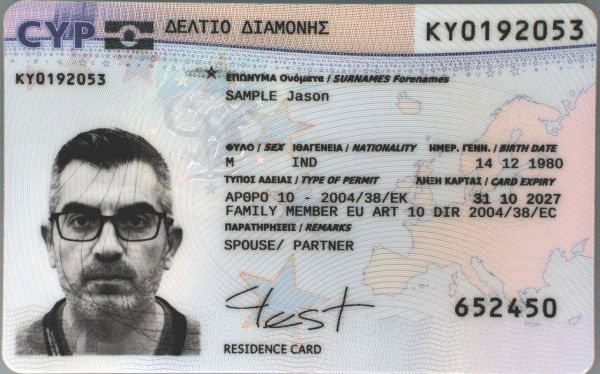
EU nationals and their non-EU family members staying in Cyprus for more than 90 days must apply for MEU1 and MEU2 residence permits.
These permits offer a faster and more streamlined process than other residence permits, with documents typically issued immediately or within 5–10 business days. Holders gain access to healthcare, education, and employment opportunities in Cyprus.
MEU1 is a registration certificate for EU citizens to confirm their legal residence in Cyprus for over 90 days. The certificate has no expiration date and does not need to be renewed.
Specific categories of EU citizens eligible for MEU1 include:
MEU2 is a residency card issued to non-EU family members of EU citizens holding an MEU1 certificate. The card is valid for up to 5 years, meaning that it has to be renewed if its holder wants to stay in Cyprus for longer.
Eligible family members include:
MEU2 holders have the right to work or engage in self‑employment in Cyprus.
The Cyprus Golden Visa provides a pathway to permanent residency for foreign investors as an alternative to temporary residence permits.
Minimum investment. The status can be granted to an applicant who invests at least €300,000. There are four qualifying investment options:
When investing in residential real estate, applicants can only buy primary properties. Under the commercial real estate option, the property can be bought in both primary and secondary markets. Under both options, investors can buy one or two properties but cannot combine residential and commercial real estate investments.
Applicants must retain their investments while they want to keep permanent residency or until they obtain Cyprus citizenship. The investor can apply for a passport after 8 years of being a Cyprus resident, including 5 years of physical presence in the country.
Requirements for investors. The main applicant must be over 18 years old and meet the following requirements:
After becoming a Cyprus resident, investors are required to visit the country at least once every two years.
Family members. The investor’s spouse and children under 18 can be added to the application. Children between the ages of 18 and 25 can also apply, provided they are unmarried, financially dependent on the investor, and enrolled in a university outside Cyprus.
When the investor adds family to the application, the minimum annual income requirements increase by €15,000 for the spouse and by €10,000 for each child.
According to the experience of Immigrant Invest’s experts, the entire process of obtaining a permanent residence permit in Cyprus can take at least 9 months.
A successful applicant receives the status for life. However, permanent residence cards must be renewed every 5 years.
Before preparing the application, it is mandatory to undergo a preliminary Due Diligence check to identify any issues that may arise.
The procedure is completed by Immigrant Invest’s Compliance Department. It is confidential and only takes one day, helping to reduce the rejection risk to 1%.
Immigrant Invest lawyers compile a list of required documents, help investors collect them, and then translate and apostille them. The set of documents depends on the investment option chosen by the applicant.
Immigrant Invest specialists help the applicant to complete the investment in Cyprus. Investors are not required to travel to the country: for example, those purchasing residential or commercial real estate can examine a property via a videoconference.
All the documents, including the proof of investment, are compiled and submitted to the Civil Registry and Migration Department of Cyprus.
In case of approval, the investor and their family are required to visit the country within a year to submit biometrics. Afterwards, they receive certificates and Cyprus permanent residence cards.
To maintain the status, applicants must visit the country every 2 years. The ID permanent residence card needs to be renewed every 10 years.
For trips less than 90 days, non‑EU nationals require a short-stay visa, unless their country has a visa-waiver agreement with Cyprus. All non-EU nationals need a visa if they want to stay in Cyprus for more than 90 days.
EU nationals and their non-EU family members do not need a visa if they stay in the country for less than 90 days. For longer-term stays, they can apply for special MEU1 and MEU2 residence permits.
Cyprus offers the following types of visas:
Along with the application for a residence permit, a foreigner seeking Cyprus residency submits their passport copy, proof of the purpose of stay, proof of sufficient funds, medical insurance, and certificates confirming no serious illnesses and criminal record.
Yes, Cyprus allows foreigners to obtain permanent residency by investment if they spend at least €300,000 on residential or commercial real estate, shares of Cypriot companies, or units of investment funds.
Permanent residency is granted for life to the investor, their spouse, and children under 25. The application procedure takes at least 9 months.
The processing time for a Cyprus visa depends on its type. For a short-stay visa, it is between 7 and 10 business days. However, it is advised to apply for a visa well in advance, but no earlier than 3 months before the intended trip.
Applications for long-stay visas are processed for longer: the procedure can take 4 or more weeks.