Cyprus permanent residence is an opportunity to live in an EU country, take your business to an international level, optimise taxes, and use the services of European banks.
One can become a permanent resident of Cyprus in several ways: by living in Cyprus for five years with a temporary residence permit, investing at least €300,000 in the country’s economy, getting permanent employment, or setting up a business on the island.




Cyprus permanent residence allows a foreigner to reside legally in the country. The status is granted for life, but the permanent residence card must be renewed every 5 years.
Cyprus grants permanent residence to:
After obtaining permanent residency in Cyprus, foreigners enjoy almost the same rights inside the country as Cypriot citizens, with a few exceptions. For example, residents cannot hold public offices or vote in local elections. Permanent residency obtained by investment does not allow employment in Cyprus, but doing business is permitted.
| Path to permanent residence | Financial requirements | Eligible applicants | Family inclusion | Processing time |
| Investment program | €300,000+ in the country’s economy; annual legal income of €50,000+ | Investors | Spouse and children under 25 | 9+ months |
| Immigration permit for highly skilled professionals | No specific financial threshold | Foreigners with permanent employment contract in Cyprus or self-employed | Spouse and minor children | 12—18 months |
| Immigration permit for financially independent persons | Passive income of €9,568+ per year for main applicant and €4,613+ for each family member | Financially independent individuals | Spouse and minor children | 12—18 months |
| Immigration permit for entrepreneurs | Company capital of €260,000—430,000 | Business people and self-employed | Spouse and minor children | 12—18 months |
| For long-term residents | No specific financial threshold | Holders of residence permits who lived in Cyprus for 5+ years | Spouse and minor children | 6—12 months |
Cyprus has a state permanent residence program for wealthy people willing to invest at least €300,000 in the country's economy. Under the program, investors obtain a life‑long status. Successful applicants are not obliged to move to Cyprus. To maintain permanent residency, they must keep their investments and visit the country every 2 years.
The investment can be returned later. If the investor obtains citizenship or ordinary permanent residence after living in Cyprus for at least 5 years, they may sell the property or withdraw other investments.
The Cyprus permanent residence program offers 4 investment paths, each of them requiring a minimum investment of €300,000:
Real estate investment is the most popular option. An applicant for permanent residence can purchase one or two properties. If buying two residential properties, both must be from the same developer.
If the applicant invested in non‑residential property, company shares, or fund units, they must also buy or rent housing on the island. In this case, there are no space or cost requirements.



Foreigners are eligible to participate in the program if they meet the following conditions:
The spouse and children can apply for Cyprus permanent residence with the main applicant. Children aged 18 to 25 must be university students, unmarried and financially dependent on the investor to qualify. Children with mental or physical disabilities are eligible for Cyprus PR irrespective of their age.
When adding family members, the investor proves an additional annual income of €15,000 for a spouse and €10,000 for each child.
The entire period of obtaining Cyprus permanent residency by investment takes 9 or more months. This time frame includes document preparation, implementing the investment condition, applying for residency and awaiting approval, and visiting Cyprus for getting permanent residency cards.
In addition to the investment sum, applicants must pay additional fees which depend on the chosen option and the number of family members included in the application.
Standard government fees which are paid when obtaining Cyprus permanent residency by investment include the following:
As for the property prices in Cyprus, they are lower than in many other European countries. For example, 1 m² of an apartment in the centre of Nicosia costs about €2,400; in Rome, the price is about €7,400.
| Expense item | Purchase of | Purchase of | |
| €300,000+ | €300,000+ | €300,000+ | |
| VAT | €15,000+ | €57,000+ | — |
| Confirmed income | €50,000+ per year | €50,000+ per year | €50,000+ per year |
€500 | €500 | €500 | |
| €70 | €70 | €70 | |
| Permanent residence card fee | €70 | €70 | €70 |
| Legal services | 1% of the | 1% of the | — |
According to Immigrant Invest’s experience, Cyprus permanent residence by investment is obtained in about 9 months. The process may vary depending on the chosen investment option. The procedure below outlines the steps for applicants investing in real estate.
The results of this mandatory step define whether there are any obstacles for the investor to become a Cypriot resident. A certified Compliance Anti-Money Laundering Officer at Immigrant Invest conducts a thorough check to evaluate the applicant’s chances and reveal possible risks.
Immigrant Invest lawyers help the investor collect, translate, and apostille the necessary documents. When everything is ready, they transfer the documents to the local agent in Cyprus.
To purchase property, the investor hires a lawyer and a notary and supervises the whole process.
Alternatively, they can turn to a reliable agent such as Immigrant Invest, which has a database of properties from trustworthy developers. The agent’s lawyers obtain permission to purchase the property, verify the transaction’s integrity, assist in concluding a purchase and sale contract, and close the deal.
At this step, the applicant transfers the €300,000 investment and VAT to the developer.
To submit the documents, the investor does not have to visit Cyprus. Our local representative will pass the documents to Cyprus’s Civil Registry and Migration Department.
The application processing takes 4 to 6 months. In case of approval, the investor and their family must visit Cyprus within a year to submit biometric data and obtain permanent residence cards. The cards are issued in about 40 days.
Investors who obtain permanent residency in Cyprus must be prepared for a number of limitations associated with their status:
If for any reason the residence permit issued to the investor is cancelled, this will result in the cancellation of residence permits of all family members.
Learn the benefits, conditions and specifics of the Cyprus Permanent Residence for investors in 2 minutes
Cyprus remains one of the most attractive EU countries for investors seeking permanent residence. The program grants permanent status right away, unlike most EU countries that issue a temporary residence permit first.
In 2025, several EU countries offer temporary or permanent residence by investment options, but with different rules. Some have lower entry thresholds, while others provide a faster route to EU citizenship. Depending on the investor’s goals — whether it’s travel, long-term settlement, or future citizenship — each program offers specific benefits and trade-offs.
| Country | Permit type | Minimum investment | Validity | Processing time | Minimum stay requirement | Family inclusion |
| Cyprus | Permanent residency | €300,000+ | For life | 9+ months | Once every 2 years | Spouse, children under 25 |
| Portugal | Residence permit | €250,000+ | 2 years, renewable twice for 2 years | 12+ months | 7 days a year | Spouse, children under 26, parents |
| Greece | Residence permit | €250,000+ | 5 years | 4+ months | Not required | Spouse, children under 24, parents |
| Italy | Residence permit | €250,000+ | 2 years, renewable for 3 more years | 4+ months | Not required | Spouse, children, parents |
| Hungary | Residence permit | €250,000+ | 10 years, renewable for 10 more years | 5+ months | Not required | Spouse, children under 25, parents |
| Malta | Permanent residency | €169,000+ | For life | 6+ months | Not required | Spouse, children under 29, parents, grandparents |
An immigration permit is granted to foreigners planning to work or do business in Cyprus. Eligible applicants include highly qualified professionals, entrepreneurs, and financially independent individuals[1].
The timeframe for obtaining the status is 12 to 18 months.
Permanent residence is granted to foreigners who have been offered permanent employment in Cyprus or who intend to work as self-employed in an occupation or science in the country. Employers can hire foreign specialists if they cannot find employees among locals or EU citizens.
The employer submits a work contract to the Cyprus Ministry of Labour for approval. The Ministry considers each situation individually and determines whether the foreigner is eligible for the position.
Permanent residence is granted to businesspeople and self-employed individuals who work in sectors of the economy that are strategically important for Cyprus. The company’s activity must not have a negative impact on the economy of the country.
The amount of the company's capital can be reduced in agreement with the Migration Control Committee.
| Agriculture, livestock, poultry, or fish farming | Mining enterprises | Trade | |
| Capital | €430,000 | €350,000 | €260,000 |
| Additional | Own land or permission to purchase it | Have a licence to operate in the | Have a licence to operate in the |
Permanent residence is granted to wealthy people with income or savings abroad. The income must be passive; the salary will not work.
The minimum annual income must be €9,568 for the main applicant and €4,613 for each family member. Pension, dividends from shares, and income from leasing real estate are suitable sources of money.
Applicants collect documents, fill in the government forms, and submit documents to the Cyprus Civil Registry and Migration Department. They also pay an application fee of €500 for all family members included in the application.
Some Cypriot residents can obtain permanent residency if they have lived on the island for 5 years with a valid residence permit. To qualify, candidates cannot leave the country for more than six months in a row or 10 months in total within the relevant 5‑year period[2].
Processing time. The timeframe for obtaining permanent residency in Cyprus after holding a residence permit is 6 to 12 months.
Qualifying residence permits which entitle their holders to Cyprus permanent residency are as follows:
Foreigners who obtained their Cyprus residency for university studies, seasonal work, diplomatic activities, temporary asylum, or as refugees, are not eligible for permanent residency in Cyprus.
A residence permit for family reunification is granted to relatives of Cypriot residents or citizens. Eligible family members include a spouse and minor children. In some cases, adult children and parents can also obtain residency if they are financially dependent on the resident or a citizen of Cyprus.
The residence permit for family reunification is usually granted for the same period as the main applicant’s residence permit. After living in Cyprus for 5 years, holders of such permits can apply for permanent residency.
Relatives of citizens of the European Union, European Economic Area, and Switzerland can also get PR in Cyprus if they have lived on the island for at least 5 years. The status is granted even if the family members are not citizens of these countries.
The following people can become Cyprus permanent residents:
A residence permit for work is granted to individuals employed in Cyprus. The maximum period of stay depends on the work permit type. Under the general rule, it is limited to 3 or 4 years, meaning holders cannot apply for permanent residency.
However, for certain categories, including athletes, coaches, workers in the farming and agriculture, specialised cooks, and highly paid employees of companies of foreign interests, the maximum period of stay is not limited. After 5 years, such foreigners can apply for permanent residency.
The application for a residence permit is submitted to the Cyprus Civil Registry and Migration Department. The standard package of documents includes the following:
Depending on the residence permit type, additional documents may be required. For example, for financially independent persons, proof of passive income is required. For permanent residence by investment, applicants must provide a declaration confirming annual income of at least €50,000, proof of investment, and a statement confirming they are not employed in Cyprus.
All documents obtained outside Cyprus must be in Greek or English or have an official sworn translation into one of these languages. When applying for a residence permit, biometric data must also be submitted.

The Civil Registry and Migration Department of Cyprus does not approve all applications for permanent residence. Refusal can be received by foreigners who:
Residence permits can also be cancelled if a foreigner fails to fulfil the conditions on which they received the status. For example, an investor sold a property before obtaining citizenship, or a qualified employee resigned from a Cypriot company.
Permanent residence is valid for life. However, permanent resident cards must be renewed every 5 years. The permanent residence permit allows the holder to obtain citizenship by naturalisation.
To qualify for a passport, foreigners must live in Cyprus for the following number of years during an 11-year period:
Before applying for citizenship, one cannot leave Cyprus for the last 12 months.
Candidates for a Cypriot passport must pass examinations on the Greek language, culture, and the Constitution of the country.
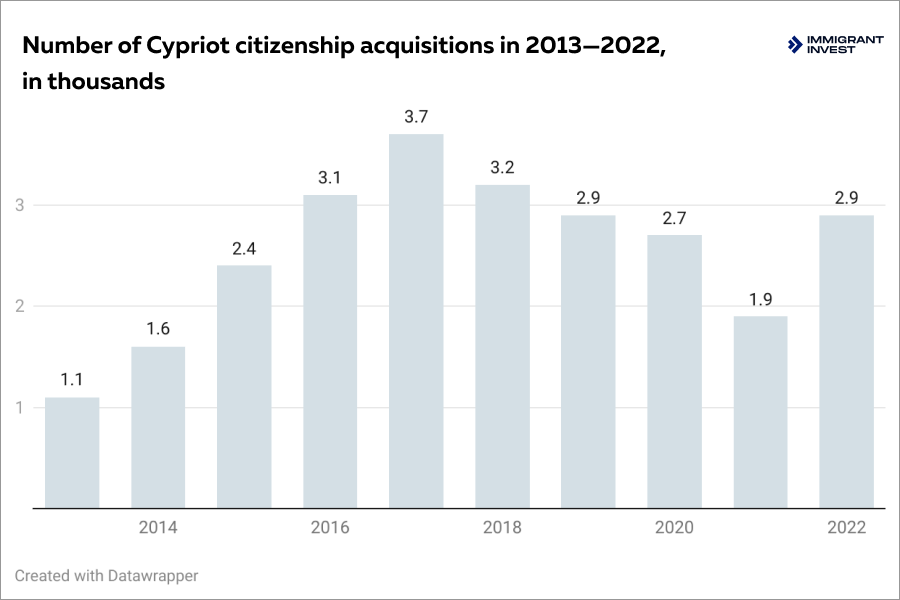
The benefits of the Cyprus residence permit and permanent residence are similar. The status choice usually depends on the goals: move to Cyprus, have a "backup plan", bring family to the country, or preserve capital.
The Cypriot passport provides more benefits than a residence permit, but it is impossible to become a Cypriot citizen directly by investment.
| Criteria | Residence permit | Permanent residency | Citizenship |
| Validity period | Up to 5 years | Lifetime | Lifetime |
| Renewal required | Yes | No | No |
| No | Yes | No | |
| Visa-free travel | No | No | 168 countries, including the Schengen Area |
At least 183 per year | For For other permanent residents — no requirements | No | |
| Right to work in Cyprus | Depends on the | Depends on the | Yes |
| Right to vote and be elected | No | No | Yes |
Cyprus permanent residence offers stability, legal rights, and access to European services and infrastructure. It allows families to live in a safe EU country, enjoy a high standard of living, reduce taxes, and plan long-term relocation or business expansion.
Cyprus permanent residence allows the holder to live on the island without time restrictions. This provides a stable legal base in the European Union, especially valuable during political uncertainty or economic turbulence in one’s home country.
In case of emergencies or border closures, permanent residents can always return to Cyprus, even when entry for foreign nationals is restricted. This makes the status a reliable backup plan.
Family members of the permanent residence holder can obtain residence permits. For example, EU citizens’ relatives may qualify under family reunification.
Investors applying under the Cyprus permanent residence by investment program can include a spouse and dependent children under 25 in the initial application. This allows the entire family to relocate together and benefit from access to healthcare, education, and long-term settlement rights.
Jonatan and his wife Emma dreamed of relocating to Europe and buying a house in a peaceful place. The obtaining process and minimal costs under the Cyprus investment program seemed the most affordable for them.
After relocation to Cyprus, the spouses spend two times less on utilities and car maintenance. A large selection of excellent medical clinics is within walking distance, and medical services are three times cheaper than in the US.
The Cypriot lifestyle, the warm sea, and the sun all year round have made them more relaxed and cheerful. The couple is planning to get Cyprus citizenship in 8 years and is considering relocating the company to Cyprus to reduce taxes.
There is no tax on inheritance in Cyprus. Corporate tax is only 12.5%, one of the lowest rates among the EU countries. Personal income tax is applied on a progressive scale from 0 to 35%.
Dividends, interest, and capital gains are tax-exempt for non-domiciled residents. There is also no tax on global income for those qualifying for the non-domicile regime.
For example, a non-domiciled investor earning dividends abroad or capital gains on international assets may pay no tax in Cyprus for up to 17 years. This is attractive for high-net-worth individuals seeking to reduce their global tax burden.
Permanent residents may apply for citizenship by naturalisation after 8 years of legal residence, provided they meet the language and integration requirements. Spouses of Cypriot citizens can qualify in just 3 years.
A Cyprus passport grants full EU citizenship rights and visa-free access to over 170 countries, including those in the EU, as well as Canada, Japan, and Singapore.
Cyprus offers a well‑developed public healthcare system. In the Legatum Prosperity Index 2023, Cyprus ranked among the top 30 countries globally for healthcare‑quality[3]. Permanent residents can receive free or low‑cost care through the General Healthcare System, or GHS, which covers routine consultations, specialist services, surgery, and chronic illness management.
Private healthcare is also available, with modern clinics and English-speaking doctors. It is generally more affordable than in many Western countries.
Permanent residents can register new companies, acquire shares in Cypriot businesses, or relocate an existing company to Cyprus. While the investment route does not permit direct employment, business ownership and receiving dividends are allowed.
Cyprus has a favourable regulatory system, a multilingual workforce, and an advantageous tax system that attracts international companies and entrepreneurs.
Permanent residents and their children can enrol in both public and private schools and universities. Public education in Greece is free, while many private schools offer British, American, or IB programmes in English, with tuition averaging €7,500 per year[4].
Universities in Cyprus accept permanent residents on the same terms as citizens. Degrees are recognised across the EU. Top institutions include the University of Cyprus and the Cyprus University of Technology, both ranked among the world’s top 1,000 in the QS World University Rankings 2025[5].
Cyprus is one of the safest countries in the world. According to Numbeo, the crime index is under 35, which is considered low[6]. Violent crime is rare, and most incidents are minor property crimes.
The island also has a stable political environment and a functioning rule-of-law system. This makes Cyprus attractive for families and retirees seeking a secure and peaceful place to live.
Cyprus has a Mediterranean climate with long, dry summers and mild winters. The island enjoys over 300 sunny days a year, making it one of the sunniest places in Europe. Average temperatures range from 17 °C in winter to 33 °C in summer, depending on the region.
Cyprus is home to 64 Blue Flag beaches as of 2025, one of the highest numbers per capita in the world. The Blue Flag is an international eco-label awarded to beaches with excellent water quality, environmental management, and safety standards.

Cyprus is a safe, stable, and welcoming place for newcomers, with roughly 27% of its population being foreign-born[7], making it one of the most internationally diverse EU countries in terms of resident composition.
The island benefits from a mild Mediterranean climate and low crime rates, offering a high quality of life and an attractive environment for long-term relocation.
Greek is the official language, but English is widely used across the public and private sectors. According to Eurobarometer data, around 77% of Cypriots speak English[8], even if it isn't their first language. This widespread proficiency means newcomers can handle daily tasks like doctor visits, banking, or shopping without fluency in Greek.
Free or low-cost municipal courses are often available and are encouraged to help integrate into local life.
Housing costs vary depending on location. Monthly rent for a one-bedroom apartment in the city centre is about €1,300 in Limassol, €900 in Paphos, and €660 in Nicosia. Property prices in Cyprus are generally more affordable than in Western Europe, especially for newly built homes outside urban centres.
The overall cost of living for a couple is approximately €2,500—3,000 per month, including rent, utilities, groceries, and transportation.
Permanent residents can open local bank accounts with a valid residence permit and proof of address. Cyprus uses the euro, and the banking system is stable and regulated by the Central Bank of Cyprus. Most banks offer online services in English, and international transfers are widely supported. Credit and debit cards are accepted everywhere.
With an estimated 264,000 expatriates living in Cyprus in 2024, which is about 22% of the population, expat networks are well‑established. The island hosts substantial communities from the UK, Russia, Germany, and Israel. Paphos and Limassol are especially popular among retirees and remote workers. Social clubs, international schools, English‑language newspapers, and community events make integration easier.
The island’s relaxed lifestyle, low crime rate, and over 300 days of sunshine per year make it ideal for long-term living. Residents enjoy outdoor activities year-round, from beach outings to hiking in the Troodos mountains. Cyprus also offers a variety of cultural festivals, concerts, and food markets throughout the year.
A foreigner obtains Cyprus permanent residence if they have lived on the island for 5 years with a residence permit. However, there is an exception.
Investors and foreigners with immigration permits get permanent residency immediately if they have fulfilled the legal conditions. For example, investors put at least €300,000 into the country’s economy, and financially independent people confirm their passive income of at least €9,568 per year.
Cyprus grants permanent residence to foreigners by investment, by an immigration permit, or after 5 years of living on the island with a residence permit.
The fastest way to get permanent residence is to invest €300,000 in the country’s economy. Investors’ applications are considered within 9 months.
Non-EU citizens must live legally and continuously in Cyprus for 5 years before applying for long-term residence. Absences must not exceed 6 consecutive months or 10 months in total over the 5-year period.
The permit is initially valid for 5 years and may be revoked if the holder leaves Cyprus for 6 years, stays outside the EU for 12 months, or obtains long-term residence in another EU country.
EU long-term residents who already hold such status in another EU country can apply for an immigration permit in Cyprus within 3 months of arrival. Their right of residence is unlimited, though the residence card is valid for 10 years and must be renewed. The application process is faster, taking around 4 months instead of 6—12.
Non-EU citizens also often obtain Cyprus permanent residence by investment or as financially independent persons, without waiting for 5 years of residence.
A temporary residence permit is issued for a fixed period, usually 1 or 3 years. Some types of residence permits can be extended.
Permanent residence is obtained for life. The resident card must be renewed every 5 years.
Cyprus’s Permanent Residence Card does not allow visa-free entry to EU countries as Cyprus is not a part of the Schengen Area. To travel, one needs a visa which is issued under a simplified procedure.
The obtaining costs depend on the permanent residence type.
If foreigners participate in the investment program, their expenses will be at least €300,000. Entrepreneurs confirm that the capital of their company is at least €250,000.
In other cases, applicants must pay only administrative fees.
Permanent residence does not always give the right to work in Cyprus. It depends on the type of permanent residence the applicant receives. For example, financially independent people are prohibited from working on the island, and their income must come from abroad.
Investors with permanent residency also cannot work in Cypriot companies. However, they can own business in the country and receive dividends.
No. Cyprus permanent residency allows the holder to live in Cyprus but does not grant the right to work or live in other EU countries. To work in another EU country, a separate residence or work permit for that specific country is required.
There are 3 options for how foreigners can get a Cyprus permanent residence permit:
Yes, you can get Cyprus residency by buying a residential or commercial property for €300,000. The status is granted for life but the investor must hold property to maintain residency.
Not all property purchases qualify for the investment-based permanent residency program.
To be eligible:
For investments in commercial property or non-residential assets, additional requirements apply, such as proof of housing arrangements in Cyprus.
Buying a holiday home or resale property below the €300,000 threshold may entitle the buyer to a visa but not to permanent residency by investment.
It depends on the type of residence you have. If you purchase a holiday home and plan to stay there occasionally, you can apply for a visa to stay in Cyprus for up to 90 days every 6 months — 180 days per calendar year.
If you are going to live in the property you own, you can obtain life-long permanent residency by investing €300,000 or more in a residential or commercial property.
Cyprus permanent residence holders must meet certain conditions to maintain their status over time.
For general permanent residence, the residence card must be renewed every 5 years. The holder must not stay outside Cyprus for more than 6 consecutive years or outside the European Union for more than 12 continuous months. Either case can lead to the loss of residency rights.
For permanent residence by investment, the status is granted for life, but the residence card must be renewed every 10 years. Investors must visit Cyprus at least once every 2 years. They must also retain the qualifying investment and continue to meet income requirements. If the investment is sold or the financial criteria are no longer met, the permit may be revoked.
Permanent residents in Cyprus enjoy almost the same rights as the country’s citizens. They can live in Cyprus without limitations, gain access to education and healthcare, and are allowed to do business in the country.
After 8 years of living in Cyprus with a permanent resident status, they can apply for citizenship.
Yes, Cyprus is considered a safe and politically stable country. It has a low crime rate and strong legal protections for residents and investors.
The country is a member of the European Union and follows EU laws and standards. Its stable economy, modern infrastructure, and reliable healthcare system make it a popular choice for permanent residency.
Cyprus offers four paths for investors seeking residency in the country, including:
All the options require investments of at least €300,000. The entire period of obtaining Cyprus permanent residency by investment takes 9 or more months. This time frame includes document preparation, implementing the investment condition, applying for residency and awaiting approval, and visiting Cyprus for getting permanent residency cards.
US citizens are taxed on their worldwide income, regardless of where they reside. Cyprus permanent residency does not eliminate US tax obligations, but it may offer several advantages.
Cyprus has no tax on foreign-sourced dividends, interest, or capital gains for non-domiciled residents. There is no inheritance tax, and the corporate tax rate is 12.5%.
Cyprus does not currently have a double taxation treaty with the US, but US taxpayers may still benefit from the Foreign Earned Income Exclusion and Foreign Tax Credit to avoid double taxation.